
The Inland Revenue Board began mandating e-invoicing on 1 August 2024, pushing companies to move from paper records to digital documentation. This change aims to modernize tax administration and make reporting more transparent and timely.
Understanding the shift from traditional invoicing to electronic processes is vital for every business. The phased rollout helps companies of all sizes adapt to new validation rules and integration requirements without disrupting daily operations.
This brief guide compares the tax regimes and the new e-invoice requirements, explains the implementation timeline, and outlines key benefits. By preparing now, businesses can protect turnover, speed up payment cycles, and stay fully compliant with inland revenue validation standards.
Key Takeaways
- The mandate started on August 1, 2024, and uses phased rollout to ease adoption.
- e-invoicing improves accuracy and speeds up payment and reporting.
- Companies must integrate systems to meet validation and compliance rules.
- Proper preparation helps avoid penalties and safeguards turnover.
- This guide will outline timeline, requirements, and implementation tips.
Understanding the Basics of SST and e-Invoicing
Getting the fundamentals right makes the move to digital billing less risky and easier to manage. This short guide explains the core roles of the service tax framework and the new electronic invoice formats used by businesses.
What is SST
Service tax remains a key part of the national tax regime and applies to many professional and service charges. Companies must record these taxes accurately in their accounting systems to protect turnover and meet reporting rules.
Integration with the new national e-invoicing system ensures taxes are captured at the point of issue. Firms will update accounting software to keep service records in sync with validation checks.
What is an e-Invoice
An e-invoice is a structured digital document (XML or JSON) that records a commercial transaction. It replaces paper invoices and is validated in real time through the national portal.
- Faster validation: Real-time checks reduce manual errors and speed up payment cycles.
- Standard format: Companies must issue e-invoices in predefined schemas to meet implementation rules.
- Lower costs: Electronic processes cut printing, postage, and storage expenses.
“Validation creates a clear audit trail by confirming each transaction with the authorities.”
| Feature | Traditional Invoice | e-Invoice |
|---|---|---|
| Format | Paper or PDF | Structured XML/JSON |
| Validation | Manual checks, delays | Real-time portal validation |
| Integration | Limited, manual entry | API-ready for accounting systems |
Key Differences Between SST and e-Invoicing Malaysia
Businesses now face a system that links invoice issuance directly to instant tax confirmation. Real-time validation replaces manual checks and makes the tax status of each document clear at issue.
Digital storage is another big change. Where invoices were often printed and filed, e-invoices are kept in structured formats that are easy to search and back up.
Accounting teams must update systems to handle automated tax calculations and unique ID assignment. This integration lowers the chance of fraud and duplicate documents.
- The Inland Revenue Board requires live validation for every invoice, not delayed reporting.
- Digital records improve audit trails and reduce reliance on manual logs.
- Companies that do not adapt risk compliance issues during tax reviews.
The end result is a faster, more accurate invoicing process that gives both companies and authorities immediate visibility into transactions, helping protect turnover and simplify reporting.
The Role of the MyInvois System in Modern Compliance
MyInvois centralizes invoice validation so businesses can confirm tax accuracy before sending documents to customers. This official government portal is where all e-invoices are submitted for real-time checks by the inland revenue.
Real-time validation prevents errors and ensures tax data is accurate before an invoice reaches a client. That reduces corrections and speeds up payment cycles.
Benefits of Real-Time Validation
The system acts as a secure hub for e-invoicing activities. Integration with accounting software automates generation and submission of e-invoices and cuts manual work.
- Compliance: Ensures invoices meet current tax requirements and inland revenue rules.
- Accuracy: Validates data at issue to protect turnover and reduce disputes.
- Efficiency: Standard formats let businesses scale invoicing processes across departments.
“Using the government solution aligns invoicing processes with regulatory requirements and improves financial transparency.”
Navigating the Mandatory Implementation Timeline
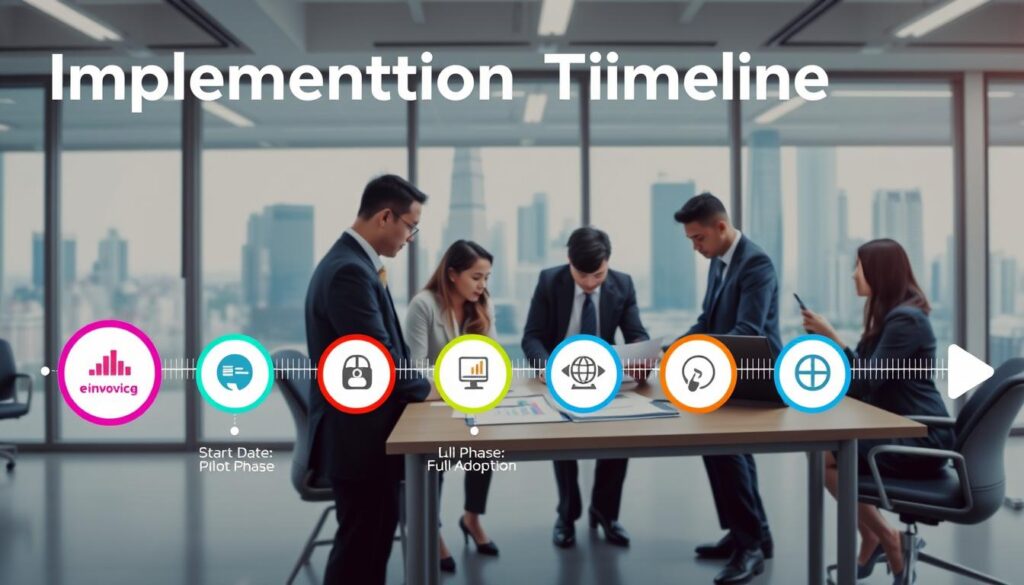
A clear timeline helps firms move methodically from paper billing to validated digital invoices. Use the schedule to plan upgrades, test integration, and train teams so the switch is smooth.
Phase One Requirements
Phase one began on 1 August 2024 for businesses with an annual turnover above RM100 million. These large taxpayers had to update their accounting systems to issue validated e-invoices and meet portal requirements.
- Confirm your turnover bracket and the official date you must comply.
- Ensure your system can generate the required e-invoice format and unique IDs.
- Test API or portal submission before the live rollout to avoid last-minute errors.
The Relaxation Period
The government granted a six-month relaxation for each phase to reduce pressure on teams. During this time, enforcement is relaxed so companies can fix technical faults and refine internal process changes.
Full Enforcement Goals
At the end of each grace period, full enforcement aims to bring all businesses into the digital fold to improve revenue tracking and compliance. Plan early, align your integration work with the official timeline, and run final checks well before the end date to avoid penalties.
“Start preparation early and test end-to-end flows to ensure smooth adoption.”
Determining Your Business Turnover and Compliance Status
Start by checking your audited accounts to see whether your firm meets the official revenue trigger for digital billing.
Annual turnover is set from audited financial statements for the 2022 Year of Assessment. Use those figures to confirm whether your firm falls below the RM1 million exemption or must join the rollout.
Businesses under RM1 million are currently exempt. If your audited revenue passes that threshold, you must follow the Inland Revenue Board’s implementation schedule and prepare your systems.
Keep clear records of turnover and the exact date you cross the mark. That date determines your compliance phase and the deadline to integrate e-invoicing workflows.
| Test | Action | Why it matters |
|---|---|---|
| Audited annual turnover | Verify 2022 figures | Determines exemption status |
| Revenue threshold | Compare to RM1,000,000 | Triggers implementation |
| Systems & integration | Plan API or portal setup | Ensures smooth compliance |
- Maintain accurate ledgers to prove status during any tax review.
- Review financials regularly so growth does not catch you off guard.
Essential Data Fields for Compliant Invoices
Completeness of data on each e-invoice drives faster checks and clearer audit trails.
Every validated e-invoice must include 55 specific data fields. These fields capture seller and buyer details, item lines, quantities, unit prices, and total tax amounts.
Standardizing this information ensures the Inland Revenue Board can validate transactions in real time. Businesses must update invoicing software to populate fields automatically and avoid costly manual errors.
- Core fields: seller/buyer IDs, contact info, and tax categories.
- Transaction lines: item codes, quantities, prices, discounts, and totals.
- Tax data: amounts payable, tax rates, and unique validation IDs.
Provide accurate information in each document to stay compliant. Regular audits of your invoice data help catch gaps early and streamline implementation across teams.
“A fully populated e-invoice is the best defence against validation failures and audit queries.”
Comparing Transmission Models for Business Integration
Choosing how invoices reach the validation portal shapes workflows, technical needs, and the daily load on accounting teams.
Direct API Integration
Best for high-volume companies. This approach links your ERP or accounting software to the government API. It automates e-invoice generation and submission in real time.
Integration reduces manual steps and cuts human error. It keeps invoices, tax data, and validation IDs synced with your systems.
Manual Portal Usage
Better for smaller businesses or early adopters. The MyInvois portal lets staff upload or enter invoices manually. This avoids heavy development work and lowers initial costs.
Manual use is practical while preparing for a full API rollout. It still submits e-invoices for official validation and preserves compliance.
- Plan the date for full integration to avoid disruptions to operations.
- Match the model to turnover, transaction patterns, and IT resources.
- Maintain consistent data quality for every validated transaction.
“Choosing the right transmission model balances cost, speed, and long-term growth needs.”
| Aspect | Direct API | Manual Portal |
|---|---|---|
| Best for | Large companies with high invoice volumes | Small businesses or low-volume users |
| Integration effort | High—requires development and testing | Low—uses web entry or simple uploads |
| Operational benefit | Real-time submissions, fewer errors, scalable | Quick start, lower upfront cost, manual control |
Managing B2B and B2C Transaction Requirements
Handling both corporate and retail sales means balancing strict validation with practical consumer workflows. Suppliers must issue an e-invoice for every B2B sale and for B2C transactions too. For retail customers, consolidated e-invoices are allowed when the buyer does not request an individual document.
For B2B: the seller must generate a full e-invoice and submit it for real-time validation so both parties retain a compliant record of the sale.
For B2C: businesses can group multiple retail receipts into one consolidated e-invoice, reducing paperwork while meeting official requirements when customers accept consolidation.
The implementation must support flexibility. Systems should automate sales capture, invoice creation, and submission to cut errors and speed reporting.
“If an error is found after validation, a 72-hour cancellation window lets businesses correct records before final submission.”
- High annual turnover firms must be extra diligent in compliance and documentation.
- Automation preserves a clean audit trail and reduces penalties risk.
Handling Exemptions and Special Cases
Not every supplier must switch to validated e-invoicing; some firms meet clear exemption conditions.
Criteria for Permanent Exemptions
Businesses with an annual turnover below RM1 million are permanently exempt from the e-invoice mandate. This rule removes the compliance burden for many small operators and sole traders.
Certain entities, such as foreign diplomatic offices and specific statutory bodies, also qualify for permanent relief. These special cases are listed in official guidance and are treated differently to simplify rollout.
Even if you are exempt today, keep clear records of your turnover and key dates. The exact date when your turnover crosses the threshold will trigger the need to start issuing validated e-invoices regardless of past status.
- Understand exemption rules so small businesses avoid needless system work.
- Keep supporting documents to prove exempt status if requested by authorities.
- Check official guidance for specific categories and updated requirements.
“Maintain clear documentation of your exemption status to avoid unnecessary inquiries.”
Monitor regulatory changes. Exemption criteria can evolve, and staying informed ensures you meet obligations promptly when your turnover or business type changes.
Overcoming Common Challenges During the Transition
Moving from paper processes to instant validation reveals gaps in systems and daily routines. Start small by mapping current invoicing flows and noting where data and handovers happen.
Technical integration is often the biggest hurdle. Test APIs or portal uploads early and run parallel submissions until the system is stable.
Staff resistance can slow progress. Offer short, focused training and a clear guide so teams see how the new process saves time.
Remember compliance risks: non-compliance can lead to fines up to RM20,000 or imprisonment for up to six months. Use that fact to secure management support for resources and professional support where needed.
“The time invested in testing and training will pay off with fewer errors and smoother operations.”
- Provide ongoing support and clear timelines tied to your annual turnover and implementation date.
- Document processes so knowledge stays inside the company.
- Engage external help for tricky integration or data issues.
Leveraging Tax Incentives for Digital Adoption
Smart use of government support can lower the initial cost of digital change and speed up adoption across your teams.
The government offers a tax deduction of up to RM50,000 per year for businesses that implement e-invoicing. This helps offset software, integration, and setup costs when you implement e-invoicing across your sales and accounting systems.
Accelerated capital allowance is also available for ICT equipment and software. Claiming this lets firms write off qualifying purchases faster and improves cash flow during the transition.
- Claim the RM50,000 deduction against eligible implementation costs to reduce taxable income.
- Use accelerated allowance for hardware and software purchases to recover costs sooner.
- Invest in robust solutions to improve sales processing and gain clearer revenue visibility.
“Leveraging tax incentives turns compliance spending into a strategic investment for growth.”
| Incentive | Eligible Spend | Benefit |
|---|---|---|
| Tax deduction | E-invoicing implementation costs | Up to RM50,000 deduction per year |
| Accelerated allowance | ICT equipment and software | Faster tax relief, improved cash flow |
| Business outcome | System integration and software | Better sales processes and revenue tracking |
Work with your tax advisor to confirm eligibility and document claims. As annual turnover grows, these incentives make ongoing integration and software upgrades more affordable. Use them to build a resilient, efficient digital solution for invoicing and reporting.
Best Practices for Internal Audit and Data Security
A robust audit program combines automated checks with hands-on reviews to keep invoicing accurate and secure. Build routines that test required fields and confirm each invoice meets validation rules before submission.
Focus audits on data accuracy and transmission security. Verify that the 55 required fields are populated correctly and that the channel to the tax portal uses encryption and strong authentication.

Use digital certificates to sign every document. This step guarantees the integrity and authenticity of information sent to the government.
Combine continuous monitoring software with periodic manual checks. Automated alerts spot anomalies in real time while auditors investigate root causes and fix the process.
- Provide ongoing support and training for accounting teams so systems run smoothly.
- Run regular audits of software and integration points to reduce risk for businesses and companies.
- Ensure secure, encrypted channels for all data transmission as a non-negotiable control.
“Strong internal controls and digital signing are the backbone of compliant e-invoicing.”
Conclusion
A clear plan helps businesses record revenue accurately and meet tax rules. ,
Start early so your team can test systems, verify the annual turnover trigger date, and meet all technical requirements for rollout and later phases.
The myinvois system and modern accounting tools make implementation easier and boost compliance. Firms that adapt gain faster payments, lower costs, and better data for audits.
This guide aims to simplify the steps you need to follow. Stay updated on official announcements and treat this change as an opportunity to improve operations.