Since July 1, 2025, qualifying construction and renovation work in Malaysia has been subject to a 6% service tax. The key question for many firms is whether their taxable work reaches the registration threshold.
A business must register when its taxable service value exceeds RM1,500,000 over a 12-month period. Project classification can affect the total, so contractors, subcontractors, renovation firms, project managers, and commercial property businesses should review their contracts.
Small details can change what you owe. This guide explains taxable work, residential exclusions, material costs, stage payments, invoices, and project records. RMCD updated its construction guide on March 17, 2026, so check the latest guidance before applying the rules to a specific contract.
Key Takeaways
- The 6% rate took effect on July 1, 2025.
- Registration applies when taxable service value passes RM1,500,000 in 12 months.
- Project type can affect the threshold calculation.
- Review residential exclusions, materials, and payment stages.
- Keep clear invoices and project records, and check current RMCD guidance.
Understanding SST Construction Malaysia and the July 2025 Rules
Group L sets the rules for certain building-related services. Its expanded scope took effect on July 1, 2025, under the Service Tax Act 2018 and P.U. (A) 172/2025. Providers should check whether their work is now subject to service tax.
Which contractors and projects are affected
Main contractors, subcontractors, renovation firms, civil contractors, and mechanical and electrical providers should review their taxable services. Registration depends on each provider’s taxable service value over a 12-month period—not a job title or project label. The threshold is RM1,500,000.
Rules generally cover commercial and other non-residential buildings. Residential buildings and related public facilities have a separate exclusion, so check the project details before classifying a contract.
How Group L services are defined
The scope includes construction, extension, installation, repair, renewal, removal, renovation, alteration, dismantling, and demolition. It also includes facility maintenance during the construction period. In short, the contract’s actual work matters when deciding if a service is taxable.
| Provider or work | What to review | Key point |
|---|---|---|
| Main or subcontractor | Qualifying service value | Check the RM1,500,000 threshold |
| Renovation or M&E firm | Contract scope and activities | Classify the work performed |
| Residential project provider | Building type and related facilities | Review the specific exclusion |
Identify Taxable Construction and Renovation Work
A project’s label alone does not decide its tax treatment. The actual tasks, systems, and contract terms matter. Commercial buildings and infrastructure may qualify when they meet the prescribed rules.
Buildings, infrastructure, and engineering systems
Covered projects can include roads, bridges, tunnels, pipelines, sewer works, dams, and reclamation. Mechanical, electrical, water, gas, and telecommunication systems may also count as construction services under Group L.
Renovation and other covered activities
Work may include installation, repair, renewal, removal, alteration, dismantling, or demolition. Facility maintenance during the project period may also qualify. For example, ABC Sdn Bhd’s Klang Valley office renovation included glass partitions, new flooring, repainting, and rewiring. Those tasks may make the commercial project taxable.
Use documents to classify the work
Review the contract, bills of quantities, and invoices. They show what the contractor agreed to do and how the value breaks down. A project name alone cannot confirm whether services are subject to service tax.
| Evidence | What it shows | Why it matters |
|---|---|---|
| Contract | Agreed tasks and terms | Defines the work scope |
| Bills of quantities | Items and estimated values | Clarifies included activities |
| Invoices | Billed services and charges | Supports tax classification |
Check the Residential Buildings and Public Facilities Exclusion
RMCD guidance excludes qualifying work on residential buildings from the construction service tax scope. The exclusion also covers public facilities that serve those homes. This rule can apply to eligible residential construction services, but it does not cover every building in a housing development.
For example, Mr. Lim’s Penang apartment remained a residential building even though he rented it out for business purposes. Renovation work on its kitchen, bathroom, tiles, and paint was not subject to service tax in this example.
Separate residential, commercial, and shared work
Commercial property and standalone commercial facilities do not gain the exclusion just because they sit within a residential project. Mixed-use plans may include both taxable and excluded services, so classify each part with care.
- Review the contract, drawings, bills of quantities, and invoices.
- Identify each building, shared area, and related facility.
- Keep records that support the value assigned to each type of work.
Clear records help a contractor explain why specific services qualify for the exclusion and distinguish them from work that may face tax.
Test the RM1,500,000 Registration Threshold
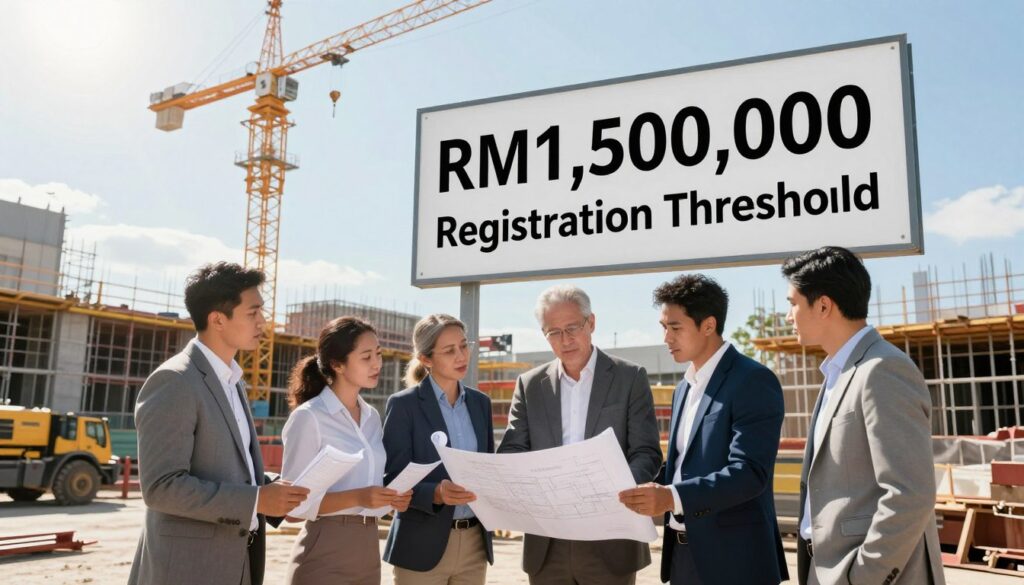
A person generally must register when taxable construction work services exceed RM1,500,000 during the applicable 12-month period. The threshold applies to taxable service value, not every amount received by a business.
RMCD guidance allows a historical or future rolling-period test. Review billings and forecasts often, since a new contract or payment can change the total.
Calculate taxable services and classify projects
Qualifying residential construction and related public facilities stay out of the taxable-work total. Keep plans, contracts, and invoices that support each classification.
An exemption is different. Some exempt Federal Government, state government, or local authority projects may still count toward registration, and government treatment can vary. Confirm the applicable relief before excluding a project. A payment exemption does not automatically remove its value from the threshold.
| Project treatment | Threshold calculation | Records to check |
|---|---|---|
| Qualifying residential work | Exclude from taxable-work total | Plans and scope documents |
| Related public facilities | Exclude when qualifying | Project and facility details |
| Exempt government project | Confirm whether value counts | Relief terms and contract |
Determine the Taxable Value of Construction Services
The contract helps show which charges may form part of the taxable amount. Materials can count when a contractor supplies them and permanently installs them as part of the work. This may affect the service tax due on construction services.
Include materials supplied by the contractor
When one contract covers both materials and installation, the materials’ value may be included in the service amount. If goods and services cannot be separated, RMCD’s guide says the full construction amount may be considered for tax.
Separate customer purchases and mixed project costs
A labor-only contract works differently: the customer buys materials separately, and the contractor generally accounts for the service fee. Clear descriptions help explain each charge.
For ABC Sdn Bhd’s RM300,000 office renovation, consistent quotes and invoices can show what the contractor supplied and what the customer purchased.
- List labor and supplied materials in the contract.
- Record customer-bought items separately.
- Identify excluded parts of a mixed project.
Keep each value easy to trace. Clear records help a business explain how it calculated the taxable amount.
Apply the 6% Rate to Payments and Project Stages
When a bill is due can affect when service tax applies. The rate for taxable construction work services is 6% for work provided from July 1, 2025. In most cases, a contractor accounts for tax when payment arrives. If approved to use invoice-basis accounting, the invoice date applies instead.
Account for progress billings and stage payments
For staged projects, account for tax as each payment comes in. A payment left unpaid for more than 12 months must still be declared. Track each bill and receipt so the taxable amount stays clear.
Handle retention sums, earlier work, and variations
Retention sums become subject to service tax when received. If the period spans the start date, tax applies only to the share tied to work done from July 1, 2025. The same date rule applies when a project began earlier: only services provided from that date fall under the expanded rules.
- Apply tax to taxable variations and eligible work after the start date.
- Do not charge service tax on penalties or out-of-court compensation for loss, including delay compensation.
Keep payment records linked to the contract and work period. This makes each tax decision easier to support.
Register, Invoice, and Maintain SST Records
Good records make tax reviews easier and help each person support how they handled a project. Set a regular check for invoices, payments, and changes to the work scope.
Prepare invoices and keep project documents
Registered contractors may issue invoices as e-Invoices, paper documents, or PDFs. Show the client’s details, a clear service description, and the 6% service tax amount for taxable work. For an exempt business-to-business project, include the client’s registration number and the exempt value.
“Clear records make it easier to explain each tax decision.”
Keep contracts, award letters, bills of quantities, drawings, progress claims, invoices, and relief evidence for seven years.
Check relief and review project records
Before billing, check the registration status of relevant contractors, subcontractors, and customers. Confirm the exact terms for government, business-to-business, or other relief. A project’s status alone does not prove that relief applies.
Reconcile records often. Match variations, payment entries, retention sums, and invoice descriptions to the work performed. This helps keep tax reporting aligned with the contract and services delivered.
Conclusion
Malaysia’s expanded construction service tax rules took effect in July 2025. The 6% rate applies to qualifying construction work and services. Before registration, contractors should compare taxable service values with the RM1,500,000 limit over the relevant 12-month period.
Classify commercial construction separately from eligible homes and related public facilities. Keep contractor-supplied materials apart from customer purchases, and link stage payments and retention sums to each project. Clear work records help support these details.
Before applying tax, review the contract scope, invoices, and exemption evidence against current RMCD guidance. These checks help a business apply service tax consistently and explain each decision with confidence.