The national e-invoice rollout began on August 1, 2024, with four phases that bring different groups of taxpayers into the system. Phase 4 started on January 1, 2026, covering taxpayers with annual turnover or revenue of up to RM5 million, subject to exemption rules.
However, the RM5 million band does not mean every smaller business has the same duties. The government raised the exemption threshold from RM1 million to RM3 million, effective September 1. Checking the conditions matters, since eligibility can depend on more than turnover alone.
This guide explains how the MyInvois framework turns paper or PDF records into structured, digitally validated data. It connects implementation phases, transaction rules, and compliance steps so you can identify what applies to your business and what to prepare next.
Key Takeaways
- The rollout uses four implementation phases.
- Phase 4 covers eligible taxpayers up to RM5 million in annual turnover or revenue.
- The RM3 million exemption has specific conditions to check.
- MyInvois validates structured digital records.
- Review your dates, transactions, and reporting duties.
Malaysia e-Invoice 2026: Who Must Comply
The rules apply to taxpayers who carry out commercial activities in the country. The implementation covers individuals and legal entities, while annual turnover helps set many start dates. Eligible businesses may also adopt the process early to test their workflows.
How digital invoicing changes business records
A PDF alone does not meet the format standard. Businesses submit structured, machine-readable data, such as XML or JSON, through MyInvois. The government platform validates invoice details and supports consistent tax reporting. Early adoption can help teams find gaps before compliance becomes mandatory.
Which taxpayers and transactions are included
The rules cover B2B, B2C, and B2G activity linked to commercial work in the country. They apply across companies and individuals, with annual turnover revenue helping determine when many taxpayers enter the system. Check the requirements for each transaction type, since invoicing steps may differ.
| Transaction type | Example parties | Record format |
|---|---|---|
| B2B | Business to business | Structured data |
| B2C | Business to consumer | Structured data |
| B2G | Business to government | Structured data |
Malaysia’s e-Invoice Implementation Dates and Turnover Bands
Your start date depends on your annual turnover or revenue band. Each phase also has a relaxation period, so separate the formal start date from the end of that period.
Deadlines by annual turnover or revenue
Phase 1 began on August 1, 2024, for taxpayers above RM100 million. Phase 2 followed on January 1, 2025, for revenue above RM25 million and up to RM100 million. Phase 3 began July 1, 2025, for more than RM5 million and up to RM25 million.
Phase 4 starts January 1, 2026, for businesses with turnover up to RM5 million, subject to exemption criteria. Its relaxation period runs through December 31, 2027. Earlier phases have shorter periods, as shown below.
Records that set your start date
Established taxpayers generally use FY2022 audited statements to identify their band. If no audit was required, check the YA2022 tax return. Qualifying businesses that began operations from 2023 through 2025 and reach at least RM3 million in revenue have a July 1, 2026 start date.
| Phase | Annual turnover or revenue | Start date | Relaxation ends |
|---|---|---|---|
| 1 | Above RM100 million | August 1, 2024 | January 31, 2025 |
| 2 | Above RM25 million to RM100 million | January 1, 2025 | June 30, 2025 |
| 3 | Above RM5 million to RM25 million | July 1, 2025 | December 31, 2025 |
| 4 | Up to RM5 million | January 1, 2026 | December 31, 2027 |
The RM3 Million Exemption and Its Eligibility Rules
Some smaller businesses may not need to issue digital invoices, but a low income figure alone does not confirm eligibility. Check both the business’s own results and its links to other entities before relying on an exemption.
When businesses below the threshold may be exempt
Eligible taxpayers with annual turnover or revenue below RM3 million may qualify. This can include relief from issuing e-invoices and self-billed e-invoices. The threshold rose from RM1 million to RM3 million, effective September 1, 2026. It differs from the January 2026 Phase 4 start, so check the rules that apply to your business.
How ownership and related entities affect eligibility
Connected entities can change the result, even when a business earns less than the limit. Review whether any of these apply:
- A non-individual shareholder or holding company has revenue of at least RM3 million.
- A related company or joint venture partner meets that revenue level.
- The business falls under an exception that requires implementation from July 1, regardless of its own turnover.
Keep a written note of the ownership checks and relevant financial records. Confirm the effective date and tax duties with a qualified adviser if your group structure is complex.
How MyInvois Validation Works
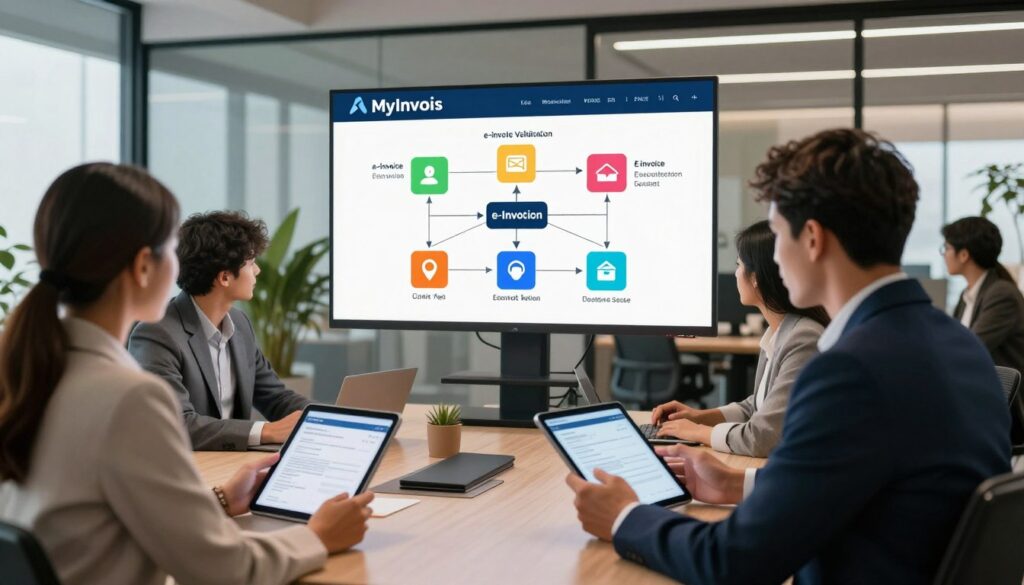
The MyInvois system checks each submitted record before it becomes a validated e-invoice. This quick process helps businesses confirm key details and keep a clear digital audit trail.
From submission to buyer notification
Create the invoice, then send its data through the MyInvois portal or an API. LHDN’s system usually completes validation in under two seconds. Accepted e-invoices are stored in its database.
After successful issuance, the supplier receives an IRBM Unique Identifier Number, timestamp, validation link, and QR code. Both supplier and buyer get a notification. The delivery method depends on the submission channel.
“Scan the QR code to check that the validated e-invoice exists and view its current status.”
Identifiers, QR codes, and corrections
The QR code gives the buyer a simple way to verify the transaction. A supplier may cancel an e-invoice, or a buyer may reject it, within 72 hours of the date of validation.
After that window, correct errors with a credit note, debit note, or refund note. This process supports accurate records and helps maintain tax compliance.
| Stage | What happens | Useful detail |
|---|---|---|
| Submission | Send invoice data through the portal or API | LHDN checks the details |
| Validation | Receive an identifier and QR code | Usually takes under two seconds |
| Correction | Cancel or reject within 72 hours | Later changes need a note |
Choosing Between the MyInvois Portal and API Integration
Taxpayers can send each e-invoice through the MyInvois Portal or connect by API. Choose a model that fits transaction volume, staff time, and current software. This choice shapes daily e-invoicing work and the wider implementation process.
When manual submission is a good fit
The MyInvois Portal suits businesses with few invoices or no compatible accounting software. Staff enter the details through its web interface, then submit them for validation. This route can help a small team avoid the cost of technical integration. The portal may also suit a business that wants a simple way to manage its invoicing tasks.
Connecting accounting and business systems
With API integration, accounting or ERP software sends invoice data directly to the MyInvois system. This system-to-system link can reduce repeat entry for businesses with many transactions. However, integration brings setup and ongoing costs. Compare those costs with your workload before choosing.
- Review invoice volume and staff capacity.
- Check whether current software supports integration.
- Consider validation needs and long-term costs.
A practical model should fit both your daily process and your budget.
Required Invoice Data and Supported Document Types
Good submissions start with clean records, not a rush at the point of sale. MyInvois e-invoicing requirements can cover up to 55 fields, with the full list in the appendix to LHDN’s guideline. The MyInvois portal may ask users to enter many of these details by hand.
Supplier, buyer, transaction, and tax details
Prepare supplier and buyer names, Tax Identification Numbers, addresses, and contact details. Each invoice may also need its date, time, number, currency, document type, and exchange rate, when one applies.
For each line, record its description, quantity, unit price, discount, subtotal, tax rate, and total. Accurate customer data and accounting records make the submission process smoother and help support tax reporting.
Invoices, credit notes, debit notes, and refund notes
The system supports standard e-invoices and self-billed equivalents. Businesses may also issue credit notes, debit notes, or refund notes to reflect changes after issuance. Check the document type before sending each transaction, so the record matches the business event.
| Document type | Common purpose | Available form |
|---|---|---|
| Invoice | Records a sale | Standard or self-billed |
| Credit note | Reduces an amount due | Standard or self-billed |
| Debit note | Raises an amount due | Standard or self-billed |
| Refund note | Records a refund | Standard or self-billed |
Consolidated E-Invoices and Transactions That Need Individual Invoices
Knowing when to group sales—and when to separate them—can make daily invoicing easier. Suppliers may combine eligible receipts or invoices into one consolidated e-invoice, especially when a B2C customer does not ask for an individual record.
Submission timing and eligible sales
Send each monthly summary through MyInvois within seven calendar days after month-end. Set a regular review time so staff can check receipts and submit the record promptly. This step helps businesses keep e-invoicing tasks on track during implementation.
Transactions that need separate records
From January 2026, any single transaction above RM10,000 needs an individual e-invoice, even during a relaxation period. The rule applies across phases. Some categories also require separate invoices, no matter the amount. These include automotive, aviation, construction, licensed betting and gaming, and payments to agents, dealers, or distributors. Electricity and specified telecommunications transactions also fall under individual-invoice rules.
Check each sale before grouping it. A short review can help your business choose the right record and avoid a missed requirement.
| Sale or activity | Record needed | Key timing or condition |
|---|---|---|
| Eligible customer receipts | Consolidated e-invoice | Submit within seven calendar days after month-end |
| Transaction above RM10,000 | Individual e-invoice | Required from January 2026 |
| Restricted industries and services | Individual invoice | Includes listed sectors and specified utility transactions |
When Businesses Must Issue Self-Billed E-Invoices
In limited cases, a buyer creates an e-invoice for a supplier. LHDN allows this method only for listed situations, so a missing invoice alone does not permit self-billing.

Common cases involving foreign suppliers, agents, and individuals
Businesses may need to self-bill for payments to foreign suppliers, agents, dealers, distributors, or individuals who do not run a business. Other listed cases include e-commerce platform fees, profit distributions, certain interest payments, betting and gaming payouts, and qualifying insurance claims or benefits.
These rules help taxpayers record each transaction correctly for tax reporting. Check the current e-invoicing guidance before handling unusual transactions, as the permitted process depends on the payment type.
What buyers need to collect and verify before self-billing
Before issuance, collect the supplier’s name, address, Tax Identification Number, and relevant transaction data. Confirm that the case meets LHDN’s requirements and that the details match your records. Keep supporting documents with the self-billed record.
A supplier’s failure to send an invoice does not, by itself, authorize a buyer to create one. Use self-billing only where the rules allow it; otherwise, request the correct document. This helps businesses maintain clear invoices and supports a sound business process.
Phase Four Relaxation and the E-Invoice Voluntary Disclosure Program
The Phase 4 relaxation period gives eligible taxpayers more time to adjust their invoicing process. It runs through December 31, 2027, but some key rules still apply.
Consolidation concessions through December 2027
For taxpayers in the up-to-RM5 million band, the January 2026 implementation date begins the relaxation period. Eligible businesses may use consolidation concessions during this time. However, a single transaction above RM10,000 still needs an individual invoice. Check each sale and its date before grouping invoices.
Using voluntary disclosure to correct past errors
The e-Invoice Special Voluntary Disclosure Programme runs from July 7, 2026, to December 31, 2027. When taxpayers meet LHDN’s conditions, they may disclose missed submissions or correct erroneous or noncompliant e-invoices. Back-filing must follow the required formats and rules.
This program does not replace ongoing compliance. Keep meeting current e-invoicing requirements for new transactions and submissions. A careful review of past records can help identify issues, while clear invoicing steps support accurate reporting.
Noncompliance Penalties and Tax Exposure
Missing a valid e-invoice can bring more than extra paperwork. For businesses, each record matters: penalties may apply to every noncompliant invoice, not just once for a reporting period. Several missed sales can therefore raise a taxpayer’s exposure.
Potential fines and imprisonment under the Income Tax Act 1967
The Income Tax Act 1967 sets out the relevant duties. Section 82C addresses record requirements, while Section 120(1)(d) is the cited offence provision. Under the Income Tax Act 1967, failure to issue a valid invoice may lead to a fine of RM200 to RM20,000 per invoice, imprisonment for up to six months, or both. The exact outcome depends on the offense and its facts.
- Check every sale and keep supporting records for tax reporting.
- Review missed or incorrect e-invoices promptly to limit tax risk.
- Do not assume the relaxation period removes all duties.
Phase 4 relief runs through December 31, 2027. From January 1, 2028, normal rules resume in full for affected taxpayers. The Income Tax Act 1967 remains central to compliance, so each taxpayer should confirm which duties apply and seek professional advice when unsure. Clear processes can help protect your business from avoidable tax exposure.
How to Prepare Your Business for E-Invoicing
A clear plan can make implementation easier for your team. Start with your records, then match each sale to the right process. Small checks now can prevent delays later.
Confirm your dates and transaction rules
Check annual turnover using FY2022 audited statements or your YA2022 tax return. Then confirm your implementation date and whether the RM3 million exemption applies. Review links to shareholders, holding companies, related companies, or joint ventures.
Map sales to the right requirements. Include the RM10,000 rule, consolidation exceptions, and cases that call for self-billing.
Prepare your tools, records, and team
Review your accounting software. Choose manual entry through the MyInvois Portal or API integration with accounting or ERP software. Clean supplier, buyer, tax, and transaction data before you issue an e-invoice. Check key details against your records and tax return.
- Test the workflow in LHDN’s MyInvois sandbox.
- Train staff to spot data and process errors.
- Set a clear review step before routine submissions.
“Test the process before your team relies on it every day.”
These steps help businesses build sound e-invoicing habits and support compliance as rules take effect.
Conclusion
Four implementation phases set different start dates based on annual revenue. The first began on August 1, 2024, for taxpayers above RM100 million. Phase 4 starts January 1, 2026, for eligible taxpayers with annual turnover or revenue up to RM5 million.
If your business earns below RM3 million, confirm the exemption rules before relying on them. Check ownership links, related entities, and transaction-specific duties. A sale above RM10,000 may need its own invoice, even during a relaxation period.
Choose a submission method that fits your workload, prepare accurate records, and test the process before daily use. These steps can make e-invoicing easier to manage and support compliance for businesses in Malaysia.
FAQ
Which businesses must follow Malaysia’s electronic invoicing rules?
Most businesses and taxpayers that carry out commercial activities must comply, subject to exemptions. Check your annual turnover, business structure, and transaction types against the latest Inland Revenue Board guidance.
When do the main implementation dates apply?
The rollout began in August 2024 for the largest businesses, followed by another group in January 2025. Businesses with annual revenue of up to RM5 million generally entered the schedule in January 2026, unless an exemption applies.
Does the RM3 million figure automatically exempt a business?
No. A threshold or temporary concession does not always mean a permanent exemption. Check current guidance for the applicable turnover limit and rules on related companies, shareholders, and holding companies.
How does MyInvois validate an invoice?
The supplier submits invoice data through the portal or connected software. The system checks and validates it, then assigns a unique identifier and QR code. The supplier can share the validated document with the buyer.
Can I cancel a validated invoice?
A supplier can cancel a validated document within 72 hours of validation. After that period, the supplier should use the right adjustment document, such as a credit note, debit note, or refund note.
Should my business use the portal or API integration?
The portal can work well for low transaction volumes and manual submission. API integration can connect accounting or business software to MyInvois, which may save time for businesses that issue many invoices.
What information should an invoice include?
Include key supplier and buyer details, transaction information, amounts, and tax data. Review the required fields before submission so errors do not delay validation or affect your records and tax return.
Can a business combine several sales into one invoice?
Some transactions may be reported through a consolidated invoice, usually within seven days after the end of the month. Certain sales and industry-specific transactions need individual invoices, so check the current rules before combining them.
When does a business need to issue a self-billed invoice?
A buyer may need to self-bill in certain cases, such as payments to some foreign suppliers, agents, or individuals. Collect and verify the required supplier and transaction details before issuing the document.
What can happen if a business does not comply?
Failure to meet invoice requirements may lead to fines or other penalties under the Income Tax Act 1967. Keep accurate data, train staff, and review your process to reduce compliance and income tax risks.