
Are creators in Malaysia required to send an e-invoice? This friendly FAQ-style intro helps Malaysian creators, KOLs, and content sellers understand what the new rules mean. The LHDN/IRBM starts mandatory e-invoicing on 1 August 2024 with a phased rollout based on annual turnover. Whether you must comply depends on if your creator income is treated as a business activity and where your turnover falls in the schedule.
The mandate covers B2B, B2C, and B2G transactions and uses MyInvois for near-real-time validation. This isn’t just sending a PDF: structured submission, a Unique Invoice Number (UIN) and a QR code are central to compliance. The upcoming sections explain requirements, timeline, exemptions for some small taxpayers, required invoice details, and the practical MyInvois workflow for common creator transactions.
Preview: the guide will show concrete examples like brand sponsorships, affiliate payouts, user-generated content services, and digital product sales. We’ll also walk through e-Invoice implementation steps and what typical taxpayers must prepare so you can act with confidence.
Key Takeaways
- The mandatory start date is August 1, 2024, with phased rollout by turnover.
- Coverage includes B2B, B2C, and B2G transactions validated via MyInvois.
- Structured submission, UIN and QR code are required — not just a PDF.
- Whether you must comply depends on business treatment of creator income and turnover thresholds.
- This guide will include clear examples for sponsorships, affiliate income, UGC and digital sales.
Understanding e-Invoice in Malaysia for influencers and KOLs
Malaysia now requires structured electronic invoices that systems can read and verify instantly. An e-invoice is a machine-readable document (XML/JSON, UBL 2.1) submitted through MyInvois. It is not a screenshot or a plain PDF.
What an e-invoice is and why it’s different from a PDF
PDFs are human-friendly files you send to clients. E-invoices are data files that systems parse automatically.
After submission, the e-invoice gets a Unique Identifier Number (UIN) and a QR code if validated.
Who regulates this and what real-time validation means
The Inland Revenue Board of Malaysia (LHDN/IRBM) sets the regulations and runs the MyInvois platform. Real-time validation means you submit an invoice, LHDN checks it, then returns a validated status, UIN, and QR code for sharing with buyers.
Practical note: You can still send a polished PDF for clients, but only after the validated record exists. The system also supports credit notes, debit notes, and refund notes for corrections.
| Feature | e-invoice | |
|---|---|---|
| Human readability | High | Low (designed for systems) |
| Machine processing | Poor | Excellent (XML/JSON, UBL 2.1) |
| Validation | No | Yes — UIN and QR code issued by LHDN |
| Correction support | Manual | Formal credit/debit/refund notes in system |
Do Influencers Need to Issue e-Invoice?
When creators receive payment for services or goods, those receipts can be treated as business income under LHDN rules. If your activity looks commercial — selling sponsored posts, content packages, event tickets or merch — e-invoicing will likely apply.
When creator income counts as business activity
Income counts as business if you sell services or goods for consideration and operate like other businesses. Regular clients, set fees, and ongoing offerings are signs of business activity. That status triggers the e-invoice requirements for validated records.
Common transactions that trigger e-invoicing
- Brand sponsorship fees and monthly retainers
- UGC production packages and paid appearances
- Livestream selling commissions, digital product sales, and merch
How this applies across B2B, B2C and B2G
When you invoice brands or agencies, you act as a supplier issuing e-invoices to buyers (B2B). Selling digital goods to fans is B2C. Campaigns for government-linked bodies count as B2G and follow the same validation rules.
“Compliance is about creating a validated invoice record, not just emailing a receipt.”
Malaysia e-Invoice implementation timeline and which phase you fall under
Start dates are assigned by revenue brackets so creators can quickly find their implementation window.
Phased rollout (by annual turnover):
- > RM100 million — starts 1 August 2024.
- RM25–100 million — starts 1 January 2025.
- RM5–25 million — starts 1 July 2025.
- RM1–5 million — starts 1 January 2026 (relaxation until 30 June 2026).
How annual turnover is calculated
Annual turnover means gross revenue from business activities in the reference year. Use audited accounts or your tax return (commonly YA2022) as the basis.
Note for sole proprietors: revenue from all your businesses may be combined when determining the band. Side projects can push you into an earlier phase.
Growth, thresholds and timing
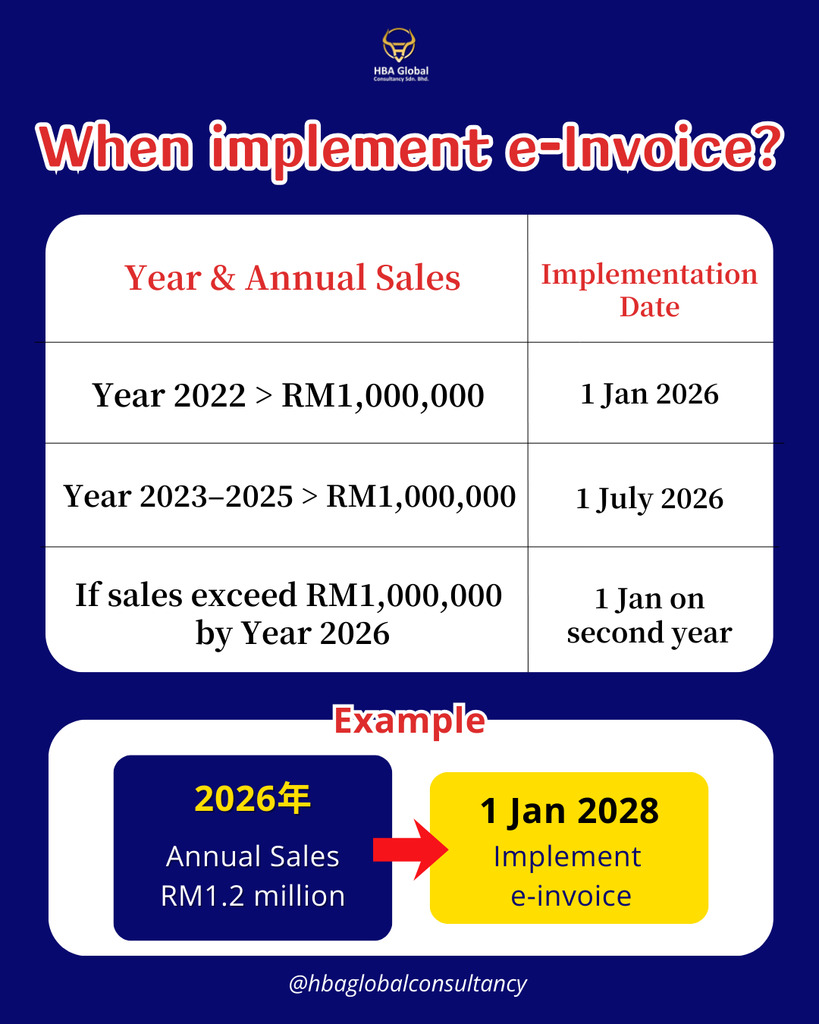
If you cross RM1,000,000, compliance usually starts in the second year after that threshold is exceeded. Once in scope, taxpayers generally remain subject even if turnover later falls.
New businesses that began 2023–2025 and hit ≥ RM1,000,000 will start on 1 July 2026. For those commencing in 2026 onward, the start date can be 1 July 2026 or your commencement date depending on first-year turnover.
Why the phased approach? It builds trust in the system and gives businesses time to prepare.
Practical tip: start collecting buyer details and test tools early so implementation is smooth when your phase arrives.
Exemptions that may apply to individual creators and small businesses
Not every small creator or micro business automatically falls under the validation rules.
How revenue-based exemptions work
If your annual turnover is below the applicable threshold, you may be exempt from immediate e-invoice requirements. That below threshold status usually means you still keep normal records but are not required to submit validated invoices yet.
What “below threshold” means in practice
One summary notes exemptions for businesses under RM1,000,000. A separate update references an MSME relief under RM500,000 with group-structure conditions.
Because sources differ, confirm which threshold and conditions apply to your case with the latest LHDN guidance.
Individuals not conducting business vs creators monetizing content
Individuals who are not conducting business are often treated as exempt individuals.
But if you sell services regularly, have contracts, or set fees, you likely act as a business and may lose that exemption.
Other exempt entities (context for creators)
Some exempt entities include foreign diplomatic or consular offices and certain statutory bodies or international organizations for limited collections before 1 July 2025.
These exempt entities are generally unrelated to creator activity and should not be relied on by content sellers.
“Exemptions exist, but they are conditional — check your facts and keep good records.”
Quick checklist
- Confirm your entity type (individual or business).
- Confirm your annual turnover against the relevant threshold.
- Decide whether your activity counts as conducting business.
- Document your conclusion for future tax and compliance reviews.
What information must an influencer include on an e-invoice
Structured data matters: an invoice must be a machine-readable UBL 2.1 file (XML or JSON) and meet submission standards so the system will validate it.
Structured format requirements and submission standards
The MyInvois Portal or API accepts UBL 2.1 payloads only. Files that do not follow the format or required schema will be rejected.
The required data fields you’ll need to collect from brands and buyers
An e-invoice can include up to 55 fields. Practically, that means collecting key buyer details early: name, tax or company ID, billing address, contact email, and any purchase reference numbers.
For sellers, include your legal name, business registration number (if any), clear service descriptions (e.g., “UGC video package”), price breakdowns, totals, and payment terms.
Digital certificate and digital signing basics for compliance
LHDN requires a Digital Certificate for signed submissions. Signing authenticates the record and prevents tampering.
If you use portal entry, the software burden is light but manual entry is heavier. If you integrate via API, ensure your software maps each field correctly before you submit.
Tip: standardize service names, maintain a master buyer sheet, and match invoice line items to contracts to reduce rejections.
| Requirement | Creator action | System impact |
|---|---|---|
| UBL 2.1 (XML/JSON) | Export or let software build UBL payload | Validates format on submission |
| Buyer and seller details | Collect and store buyer name, ID, address, contact | Reduces rejected records |
| Digital signing | Use LHDN Digital Certificate for API or portal signing | Ensures integrity and compliance |
How the MyInvois e-invoicing process works for influencer transactions
MyInvois manages the invoicing process by validating submissions almost instantly and returning a clear status for both suppliers and buyers.

B2B steps from submission to validation
After delivering agreed services, the supplier creates a machine-readable invoice and submits it via the portal or API. The Inland Revenue Board validates the file in near real time.
On success, the system issues a Unique Identification Number (UIN), a date/time stamp, and a QR code or validation link. Both parties get notified and can confirm the transaction status.
Rejection, cancellation and the 72-hour window
There is a 72-hour window where buyers may request rejection and suppliers can cancel with justification. Check amounts, buyer details, and service descriptions before submission to avoid disputes.
After 72 hours, the invoice auto-accepts. Corrections then require a credit note, debit note, refund note, or a new invoice flow depending on the error.
Record storage and status tracking
Validated records are stored in LHDN systems. Both suppliers and buyers can track invoice status, dates, and amounts via dashboards or API reporting.
Practical tip: map each validated UIN to your campaign tracker, contract, and proof of posting so audits and payment follow-ups are fast and clear.
B2C content sales and consolidated e-invoices
Small sales to many followers can be handled with a monthly consolidated e-invoice when each buyer does not request an individual record. This keeps invoicing simple for low-value transactions while still meeting validation rules.
When consolidation is allowed
If a buyer does not ask for an e-invoice, sellers may aggregate sales into one monthly consolidated e-invoice. Submit that consolidated record within seven calendar days after month-end. Schedule a monthly close routine to meet this timing rule.
When individual e-invoices are required
If any buyer requests a validated record, provide an individual e-invoice with their details. Also, industries with prohibitions must not use consolidation for certain sales.
Rule change from 1 January 2026
Any single transaction above RM10,000 must have an individual e-invoice. High-value transaction handling cannot be consolidated after that date.
Practical creator examples and tips
- RM49 preset pack sales: consolidate monthly when buyers do not request invoices.
- RM12,000 corporate workshop: issue an individual e-invoice immediately.
- Merch drops (goods), memberships and ticketed classes (services) — tag sales early so you separate high-value items.
Best practice: keep daily sales logs, mark which buyers requested e-invoices, and flag any sale above RM10,000 before month-end.
Should influencers use MyInvois Portal or API integration?
Choosing between the MyInvois Portal and an API integration often comes down to invoice volume and workflow complexity. Both routes validate records with LHDN, but they fit different use cases.
MyInvois Portal for lower volumes and manual submission
The portal suits creators and micro businesses that issue a few invoices each month. Manual entry means filling required fields or using a simple bulk upload, then checking validation status and sharing the validated copy with clients.
API integration for high-volume invoicing and automation
API links your accounting or billing software directly to MyInvois. That system automates submission, receives validation responses, and keeps invoice statuses synced.
This route uses a Digital Certificate for signed submissions and works well for agencies, multi-brand sellers, and companies processing many transactions daily.
How to choose based on transaction volume, team size, and workflow
Consider these practical points:
- Monthly invoice count — portal for low volume; API for hundreds per month.
- Sales channels and consolidation needs — API helps manage many channels and synced records.
- Team size and approval flows — automation reduces manual errors and speeds payment cycles for suppliers and companies.
- Budget for software and integration — API has higher upfront cost but lowers compliance risk over time.
“Automation reduces rejected records and keeps the invoicing process smooth when volume grows.”
Conclusion
In short, anyone earning through regular commercial activity should assume validated invoice rules apply once their turnover hits the relevant band.
Confirm your annual turnover band and your official start date under the phased rollout. Then pick the MyInvois portal for low volume or an API for automation, and standardize how you collect buyer details before each invoice.
Watch common pitfalls: missing buyer fields, sending a PDF instead of machine-readable data, and missing the 72-hour rejection/cancellation window. For B2C, consolidation may be allowed monthly, but after 1 January 2026 any single sale above RM10,000 requires an individual record.
Follow LHDN/IRBM guidelines for final answers. Non-compliance can carry penalties, including fines up to RM20,000 or prison for up to six months, so build a repeatable workflow now. Once buyer info, service descriptions and validation are routine, e-invoicing becomes simpler and builds trust with brands and buyers.